Most recent

Gavekal Research

Geoeconomic Monitor: The War Takes Its Toll
Tom Holland, Tom Miller
3 Apr 2026
Iran’s Islamic Revolutionary Guard Corps is cashing in on the war by charging the vessels of “friendly” countries a steep fee to sail through the Straits of Hormuz. If the world has to get used to paying more such fees, there will be long-term implications for global trade, writes Tom Holland. Tom Miller looks at the impact on Taiwan’s chip fabrication industry of the interruption of shipments of liquefied natural gas and helium from the Persian Gulf.

Gavekal Research
Valuing Value
Tan Kai Xian
3 Apr 2026
In recent years, value stocks—including energy, materials and industrials—have traded at a generous discount to growth stocks, especially technology-sector growth stocks. But since November 2025, much of that excess valuation discount has been eliminated. So, does it still make sense for investors to hold US value?
Gavekal Dragonomics
Crazy For OpenClaw
Tilly Zhang
3 Apr 2026
While China’s ecosystem for artificial intelligence has many things going for it, what it has so far lacked is a demonstrated willingness to pay for AI services among ordinary Chinese households. But Tilly argues that after the past month’s frenzy over OpenClaw, an open-source platform for AI agents, that seems to be changing: Chinese consumers are finally showing they will pay for at least some AI services.
Gavekal-IS
The Market’s Take On Global Trade
Didier Darcet
2 Apr 2026
It goes without saying that the closure of the Strait of Hormuz is a big deal for the global economy. However, markets have not reacted with the apocalyptic pricing response one might have expected. "Why so?" asks Didier. He seeks to answer this question using a usually reliable market-based signal for the global economic cycle involving the Swiss and Swedish equity markets.
Gavekal Dragonomics
China Finally Makes SOEs Pay Up
Andrew Batson
The Newest Strand In The Social Safety Net
Ernan Cui
Managing The Oil Shock
Thomas Gatley
The Stagflation Reaction Function
Andrew Batson
The Property Bottom Is Not Yet Here
Xiaoxi Zhang
Gavekal Research
The Eurozone Duration Question
Cedric Gemehl
Video: Collateral Damage In US Housing
Tan Kai Xian
The Sell-Off In Defense Stocks
Louis-Vincent Gave
The Consequences Of Oil Price Spikes
Charles Gave
The New World Does Not Need A Reserve Currency
Charles Gave
Gavekal Technologies
Alibaba Has A New AI Chip
Laila Khawaja
China’s AI Compute Shortage
Laila Khawaja
The Electric Vehicle Consolidation Challenge
Ernan Cui, Tom Hancock, Laila Khawaja
Another Round Of Analog Chip Price Hikes
Laila Khawaja
China Targets Full-Chain Chip Breakthrough
Laila Khawaja
Gavekal-IS
What To Do? Stay Put
Didier Darcet
Rare Cases Of Risk Asymmetry
Didier Darcet
The Global Portfolio Regatta
Didier Darcet
Money Creation, Interest Rates And Wealth Creation
Didier Darcet
Time To Take Profits On Metals?
Didier Darcet
Gavekal Research
The Policy Trap
Udith Sikand, Research Team
26 Mar 2026
For governments around the world, the policy response to the Iran war energy shock is relatively clear: if necessary chuck out fiscal rules in an attempt to protect the economy from higher energy prices. For central bankers, the choice is tougher: tighten monetary policy early to counter inflationary pressure, or hold back from raising rates and run the risk of playing catch-up further down the road. Either way, the balance of risk points to interest rate increases.
Checking The Boxes
Our short take on the latest news
Fact
Surprise
Takeaway
US Challenger job cuts rose to 60.6k in Mar, from 48.3k in Feb
NA
Job cuts are still low by historical standards; no sign of large-scale layoffs in the US
Switzerland's CPI rose 0.3% YoY in Mar, versus 0.1% in Feb
Consumer inflation cooler than 0.5% expected
Uptick due to higher energy prices; underlying inflationary pressures remain muted
Italian retail sales unchanged MoM in Feb, versus 0.6% in Jan
Weaker than expected growth of 0.4%; YoY, retail sales grew 1.6%, versus 2.5%
Demand to pick up over 2026, but a sustained energy shock is a threat
Singapore SIPMM manufacturing PMI fell to 50.5 in Mar, from 50.6 in Feb
NA
Singapore is highly vulnerable to a prolonged disruption in gas supply
Test Your Knowledge

Five countries or organizations have landed on the moon. Which was the last to do so?
- India
- Japan
- South Korea
- The European Union
- Israel
Chart of the Week
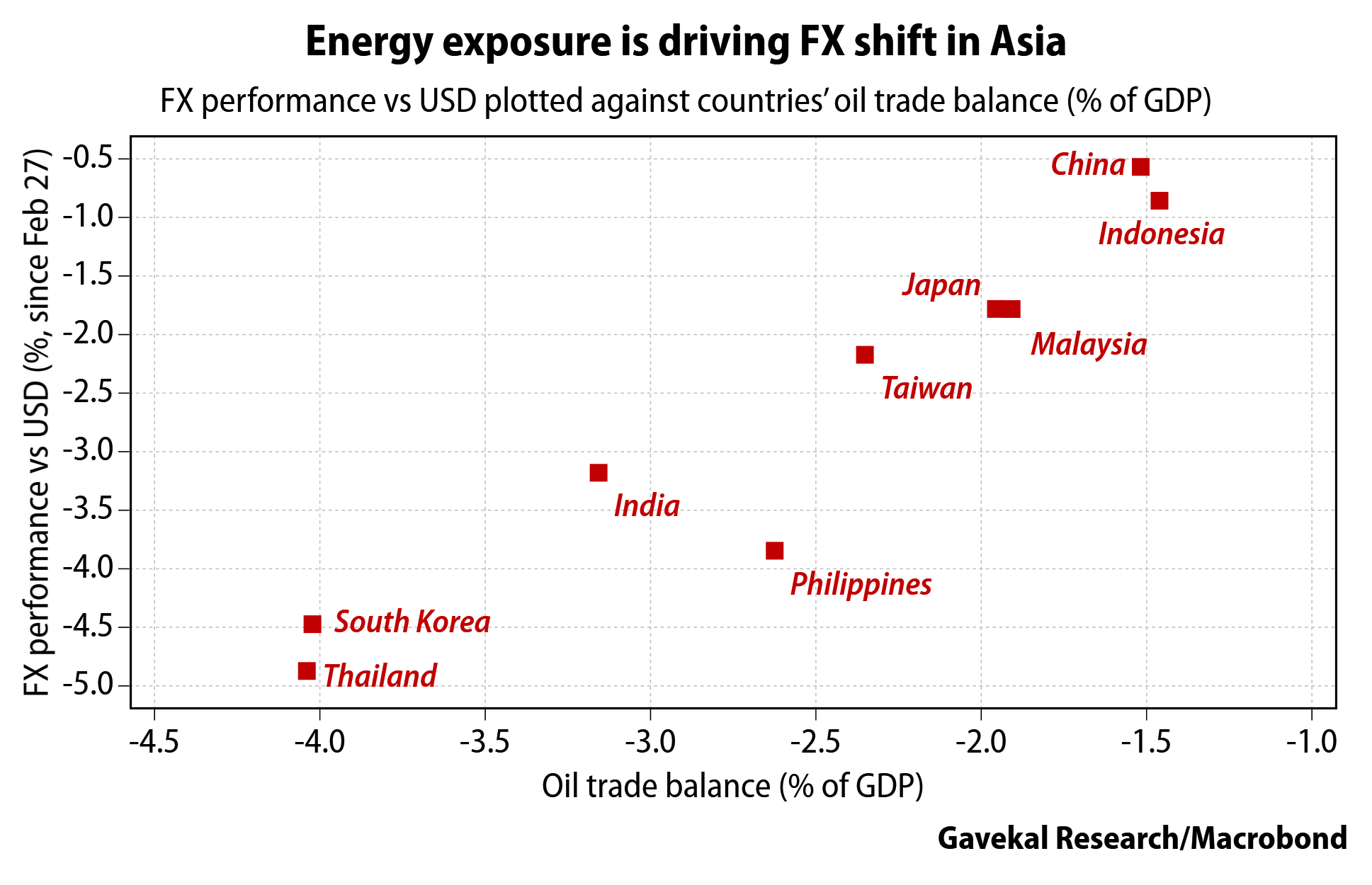
Oil prices are shifting FX rates across Asia, driven by energy dependence. More oil-intensive countries, such as Thailand, South Korea, and India are facing greater pressure, while less oil-intensive countries, such as China and Indonesia, are faring better. This reflects a terms-of-trade shock; higher energy prices threaten importers. If prices stay elevated, FX dispersion will likely widen.
Open Chart
Gavekal Research
Essential Reading: A Book For Every Week Of The Year
Gavekal is often asked for a recommended reading list. So, here it is: a book a week that everyone interested in the world of macro investing—whether hoary veteran or eager apprentice—can benefit from reading.
Gavekal Research
Webinar: Second-Order Effects
Tom Holland, Tan Kai Xian, Cedric Gemehl, Udith Sikand
26 Mar 2026
The economic fallout from the war in Iran is broadening as disrupted energy markets drive oil and gas prices higher and leave policymakers with difficult dilemmas if they are to avoid a 1970s stagflationary cycle from unfolding. Our panel considers the latest developments on the ground in the Persian Gulf and assesses what this means for the US, Europe and emerging economies.
The Iran War And Fallout
Geoeconomic Monitor: The War Takes Its Toll
Iran’s Islamic Revolutionary Guard Corps is cashing in on the war by charging the vessels of “friendly” countries a steep fee to sail through the Straits of Hormuz. If the world has to get used to paying more such fees, there will be long-term implications for global trade, writes Tom Holland. Tom Miller looks at the impact on Taiwan’s chip fabrication industry of the interruption of shipments of liquefied natural gas and helium from the Persian Gulf.
The Sell-Off In Defense Stocks
It has been a good year, and a bad month, for global defense stocks. The good year is understandable: European and Japanese defense budgets were boosted, the Ukraine war did not come to an end, the Red Sea remained blocked. Perhaps more surprising is the March faceplant in defense stocks. Since the Iran war started, global defense stocks have shed a quick -12%, almost in a straight line. So why the violent pull-back?
Next Steps In The Gulf
Asian stock markets took another leg down, and benchmark oil prices another leg up, Monday morning in Asia after Yemen’s Houthis joined the Iran conflict and speculation swirled about the next step in the war as US marines arrived in the region. At this point it is impossible with any confidence to assign probabilities to the courses of action under discussion. However, it is possible to assess the likely outcome of each of these different courses. None is encouraging.
Managing The Oil Shock
In response to the unfolding oil-supply crisis caused by the war with Iran, China’s policymakers have turned to a well-thumbed page in their crisis playbook: using state-owned enterprises to ease the domestic shock of suddenly higher prices. In this piece, Thomas explains how China can easily afford to postpone adjusting to higher oil prices, at least for a few months.
US economy & markets
Valuing Value
In recent years, value stocks—including energy, materials and industrials—have traded at a generous discount to growth stocks, especially technology-sector growth stocks. But since November 2025, much of that excess valuation discount has been eliminated. So, does it still make sense for investors to hold US value?
What Value In US Bonds?
In the four weeks since the bombing began in Iran, 10-year US treasury yields have climbed 48bp, from 3.94% to 4.42%. At this yield, do US treasuries offer attractive value? Should investors buy the dip in US bonds? To value US bonds, Will considers the “golden rule” of French Nobel laureate Maurice Allais and conducts a scenario analysis.
Bearish Gold
Gold looks increasingly vulnerable to a major correction. The rally of the past two years, which has seen the price more than double, was been driven by several factors. Monetary easing by the central banks since mid-2024 supported prices, official and private investors sought diversification in the metal, and there were concerns over Federal Reserve independence. At least two of these drivers now appear to be weakening.
More Resilient Than You Think
“Economic activity is nothing but energy transformed,” as Charles often intones. When the Iran war began on February 28, oil and gas prices spiked and global equities sold off. But US companies are better positioned than most to absorb prolonged higher energy costs if Middle Eastern oil and gas supply remains disrupted, because they have become more adept at “transforming” energy.
China chartbook
Gavekal Dragonomics
Macro Update: Preparing For Normalization
Wei He, Dragonomics Team
4 Feb 2026
China’s policymakers are satisfied with economic performance in 2025, and appear confident that 2026 will be a more ordinary year that allows for a more normal policy stance. But domestic demand remains lackluster, and it’s unclear whether recent positive momentum in some areas can be sustained. In their latest quarterly chartbook, Wei and the Dragonomics team take stock of China’s economic performance and the outlook for the year ahead.
India chartbook
Gavekal Research
India Macro Update: Downside Risks Abound
Udith Sikand, Tom Miller
23 Sep 2025
India’s domestic economic recovery is at risk as Prime Minister Narendra Modi’s government faces a lose-lose choice: continue to import cheap oil from its long-time ally Russia or face punitive tariffs in its biggest export market. Last week’s US interest rate cut will give the central bank more room to cut rates, but the underperformance of Indian asset prices looks set to continue.
Latest video
Gavekal Research
Video: Collateral Damage In US Housing
Tan Kai Xian
1 Apr 2026
It is not just US retail gasoline prices that have risen since the start of the Iran war. Long-dated US treasury yields are also up, which implies higher interest rates for new mortgage loans. In this video interview, Tan Kai Xian assesses the impact on US housing affordability and examines whether the US government will implement damage control measures.
Strategy Chartbook
Gavekal Research
Global Strategy: Best And Worst Trades For 2026
Louis-Vincent Gave, Charles Gave, Anatole Kaletsky, Will Denyer, Tan Kai Xian, Cedric Gemehl, August Gudmundsson, Thomas Gatley, Udith Sikand, Tom Miller
8 Jan 2026
Past performance is no guide to future returns, and the trend is not always your friend. As such, Gavekal writers consider their most compelling 10 macro trades for 2026, on both the upside and the downside. If one theme runs through our developed-market views, it is the expectation for a sustained inflationary boom. That story is different in China, but Chinese firms look to be on the right side of an energy transition with room to run. The view on gold is nuanced, especially seen through the lens of Japanese investors facing extreme asset valuations.
Emerging markets
Video: Are EMs Back?
It’s been a good quarter for the broad emerging markets complex. The MSCI EM index has returned almost 7% in US dollar terms, while US equities are down by some -3.5%. So should investors jump on the EM train? Udith points out that there is a wide divergence in the performance of individual emerging markets, and the threat of tariffs hangs heavy over EM corporate earnings. Investors need to be selective.
Video: Southeast Asia Under Trump 2.0
Global investors are rightly focused on the potential losers from the United States pursuing an aggressively protectionist trade policy agenda, but there may be winners as well. Tom went in search of such economies last week. Today he explains how such “swing states” are likely to perform in an intensified period of great power rivalry between the US and China.
China Turbocharges EM Investment
As the rich world pulls up the protectionist drawbridge, investors risk missing a bigger story
in emerging markets. Here, Chinese outbound investment is rebounding after the fallow Covid years, and is driving a new wave of industrialization that promises to lower the cost of the green-energy transition.
Why This Time Has Been Different
During past episodes of risk-off volatility, the correlation between emerging market risk assets has shot up. But early August’s bout of market volatility saw a bifurcation in EMs, and no broader macroeconomic spillover effects—which speaks well of the growing maturity of emerging markets as an asset class.
Europe's economy
The Eurozone Duration Question
Since the bond market sell-off of 2022, investors with long time horizons benefited from keeping eurozone government bond duration short. But since the start of the Iran war, long-dated eurozone government bond yields have climbed by nearly 50bp. So, is now the time to extend duration?
Consuming Through An Energy Shock
As hydrocarbon prices surge amid tit-for-tat attacks against energy infrastructure in the Persian Gulf, European households look exposed. Last week, we argued that this energy crisis was less threatening than the one Europe faced after Russia invaded Ukraine. Even so, the impact will depend on the size and duration of the disruption as well as the response of labor markets, fiscal policy and household saving rates.
Europe’s Energy Shock: Not 2022 All Over Again
Europe remains a large net importer of energy, so higher global energy prices typically translate into higher inflation and weaker growth. The question for investors is whether
the latest shock will prove as severe as Europe’s 2022 energy crisis. Cedric argues that the Old Continent will probably take a softer punch this time around, and analyzes the impact on its assets.
Sweden As An Indicator Of Capital Flows
The debate over whether global investors are beginning to reduce exposure to US assets has intensified. After a decade of US equity outperformance, dollar strength and deep capital market dominance, signs of diversification are emerging. Sweden offers an unusually clear window into this change.
Currencies
The New World Does Not Need A Reserve Currency
Video: Hong Kong’s Renminbi Question
What To Do With US$1trn?
On The False Price Of The Yen
Behind The Dollar’s Decline
A New Reflationary Force?
Oil & commodities
Geoeconomic Monitor: The War Takes Its Toll
Video: Japan's Macro Dilemma
Winners And Losers Of The Iran War
The Iran War Uncertainties
Injurious Exposure
Dire Straits